Overview
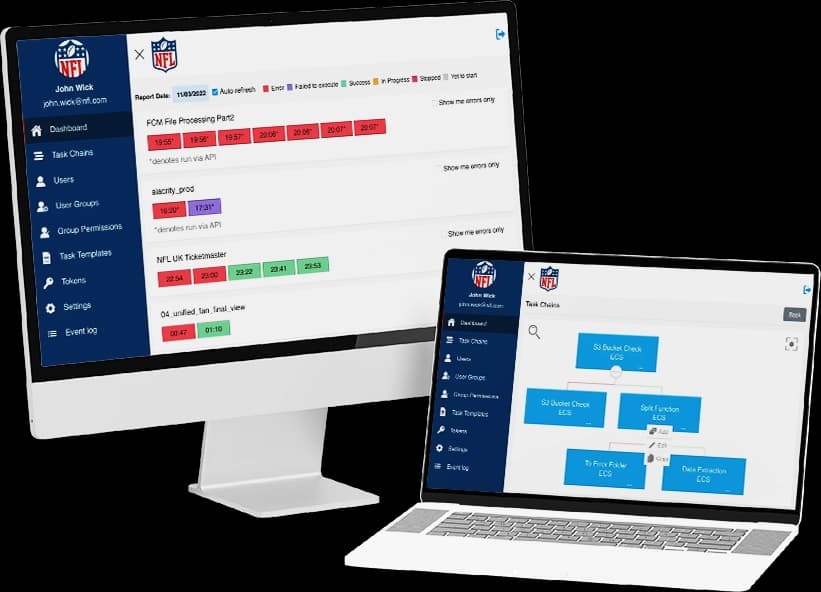
The client wanted something that could ease their way and make their work more efficient and less time-consuming. They were basically looking at three major projects: The first one was Data Task Scheduler, a serverless cloud application that used a variety of AWS services, including ECS, Lambda, Batch, and Glue, to carry out a wide range of data-intensive operations in the background. The second one was an Injury Reduction Platform, a tool for collecting data on injuries sustained by players that could also track equipment inventory and ranking, and also managed play sessions. The last one was a Data & Analytics Portal that provided all of the sports clubs with a centralized location from which the client could access data and analytics related to both the club and games.
Business Value
Data Task Scheduler We helped the client save development time and money by adapting an existing library of organizational charts to the project's needs rather than developing a new solution from the ground up. Instead of designing a new solution from scratch, we recommended utilizing a widely known library for background work schedules. This would drastically save development time and expense. To alleviate the technical burden that would have been placed on the client had they provided a detailed description of each individual operation to be performed by AWS, we developed proof-of-concept (POC) apps in advance. Injury Reduction Platform We developed a docker-containerizable solution, removing the need for a dedicated server and platform. For asynchronous AWS services like Lambda, we developed a special log parsing method to check for task statutes, eliminating the requirement for clients to manually change task status. Data & Analytics Portal Added a new Equipment Maintenance module as a standalone part of the solution, guaranteeing that the running of the legacy system would not be disrupted in any way by its addition. The present legacy system is a tabular grid with individual custom filters. We integrated Kendo Grid with features like inline recording adding and updating, numerous and composite filters per column as needed, and data grouping to improve the user's experience. The portal's efficiency and usability were greatly enhanced by the use of a custom-tailored CMS rather than an existing hefty CMS (which would have overloaded non-technical system users). Material versioning made it possible for people who lacked technological expertise to edit portal content without fear of repercussions. By including a "what-you-see-is-what-you-get " (WYSIWYG) editor that displays page styles inside content, users are now able to upload pre-styled HTML templates.